
 EN

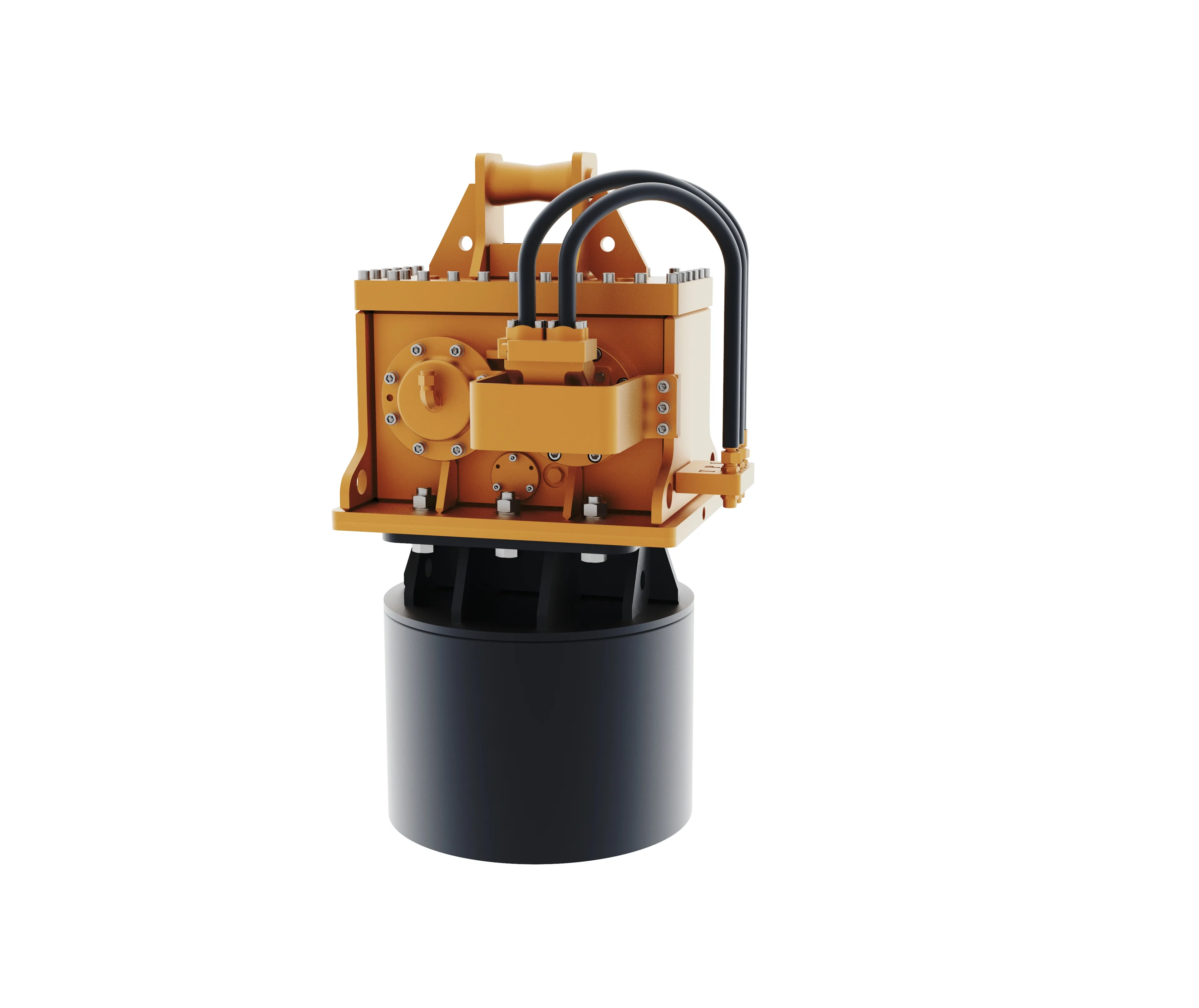
A steel cage vibro helps insert a reinforcement cage into freshly placed concrete in a cast-in-place pile until it reaches the specified position. Jiangsu Anteng Construction Machinery Co., Ltd. supplies hydraulic steel cage vibros in several sizes and can match them to cage dimensions, the construction method and the carrier.
Front and rear views of a Jiangsu Anteng steel cage vibro
1 How a Steel Cage Vibro Works
A hydraulic motor rotates eccentric weights to generate cyclic centrifugal force. A coupling or transfer rod transmits vibration to the cage. Vibration and the cage’s own weight help overcome the resistance of fresh concrete so the cage can reach the design depth. Crews typically center the cage over the bore and lower it slowly under its own weight. If it stops descending, they activate the vibrator in accordance with the construction plan.
Insertion depends on concrete workability, the time elapsed since placement and cage stiffness. A long, slender cage may bend under a load applied from the top. Depending on the cage design, a transfer rod connected at the base may be considered to draw the cage down from below.
2 Applications for Steel Cage Vibros
Continuous flight auger (CFA) piling is a typical application. CFA auger drilling equipment pumps concrete as the auger is withdrawn, after which the reinforcement cage is inserted. Building foundations, industrial plants and other projects using this method can add vibration assistance based on cage length and trial insertion results. The approach may also suit screw displacement piles that use post-inserted cages, depending on the construction plan.
Coordinate concrete placement, cage lifting and insertion. Check cage connections and alignment promptly to avoid delays that can make insertion more difficult.
3 Jiangsu Anteng Steel Cage Vibro Specifications and Selection
Jiangsu Anteng Construction Machinery Co., Ltd. offers five models with maximum centrifugal forces ranging from 149 to 532.4 kN. The models vary in weight, eccentric moment, hydraulic flow and overall dimensions. Compare them against the project requirements.
Parameter and unit |
V-150D |
V-250D |
V-350D |
V-450D |
V-550D |
Weight without sleeve (kg) |
450 |
600 |
750 |
900 |
1050 |
Hydraulic motor displacement (mL/rev) |
32 |
63 |
80 |
90 |
90 |
Max. oil flow (L/min) |
70.4 |
138.6 |
176 |
198 |
198 |
Max. oil pressure (bar) |
320 |
320 |
320 |
320 |
320 |
Max. speed (rpm) |
2200 |
2200 |
2200 |
2200 |
2200 |
Max. frequency (Hz) |
36.6 |
36.6 |
36.6 |
36.6 |
36.6 |
Eccentric moment (kg·m) |
2.8 |
4.2 |
6 |
7.6 |
10 |
Max. centrifugal force (kN) |
149 |
223.6 |
319.4 |
404.6 |
532.4 |
Length (mm) |
750 |
805 |
880 |
1000 |
1000 |
Width (mm) |
680 |
782 |
750 |
800 |
850 |
Overall height (mm) |
1275 |
1375 |
1510 |
1510 |
1510 |
Sleeves can be customized. Dimensions shown are for reference configurations. Confirm custom dimensions against the approved drawings.
Consider cage length, diameter, weight and target insertion depth together. Eccentric moment and rotational speed affect centrifugal force, while the total vibrating mass affects amplitude. Available carrier flow and pressure determine whether the vibrator can operate as specified. Cages of the same length may need different models if their reinforcement layout or weight differs.
When contacting Jiangsu Anteng Construction Machinery Co., Ltd., provide the cage dimensions, construction method and carrier hydraulic specifications so the model, sleeve size and connection can be checked against site requirements.